IRVINE, CA — October 3, 2025 — EON Reality, the global leader in Artificial Intelligence-powered augmented and virtual reality-based knowledge transfer for industry and education, today announced the launch of its SkillBuild SPV solution designed to help Workforce Boards and State Agencies transform WIOA, CHIPS, and IRA mandates into scalable, time-certain, and fully auditable training capacity. The innovative structure leverages ring-fenced financing to fund XR labs, Virtual Campus licenses, immersive content, mobile training labs, and train-the-trainer programs. Repayments are secured through diversified and contracted inflows—including employer offtake agreements, WIOA/ETPL ITAs, outcomes-based contracts, and targeted grants—while trustee-managed waterfalls and lender step-in rights ensure accountability, sustainability, and long-term impact. As detailed in its new white paper, “EON SkillBuild SPV: Bankable Workforce Transformation for the AI Era,” the model unlocks scalable, debt-free pathways for institutions to modernize training infrastructure and meet the urgent demands of the AI-driven economy.
Why public agencies need this now
Clean energy, data centers, and semiconductor projects are constrained by a shortage of job-ready technicians, while incentives increasingly require documented workforce delivery; incremental fixes won’t close the gap at required speed or scale.
Bottom line: SkillBuild SPV treats training like infrastructure so lenders underwrite contracts and collateral—not institutional goodwill—allowing workforce capacity to scale on project timelines.
What SkillBuild SPV is (public-sector view)
Click on the image below to get access to the full presentation.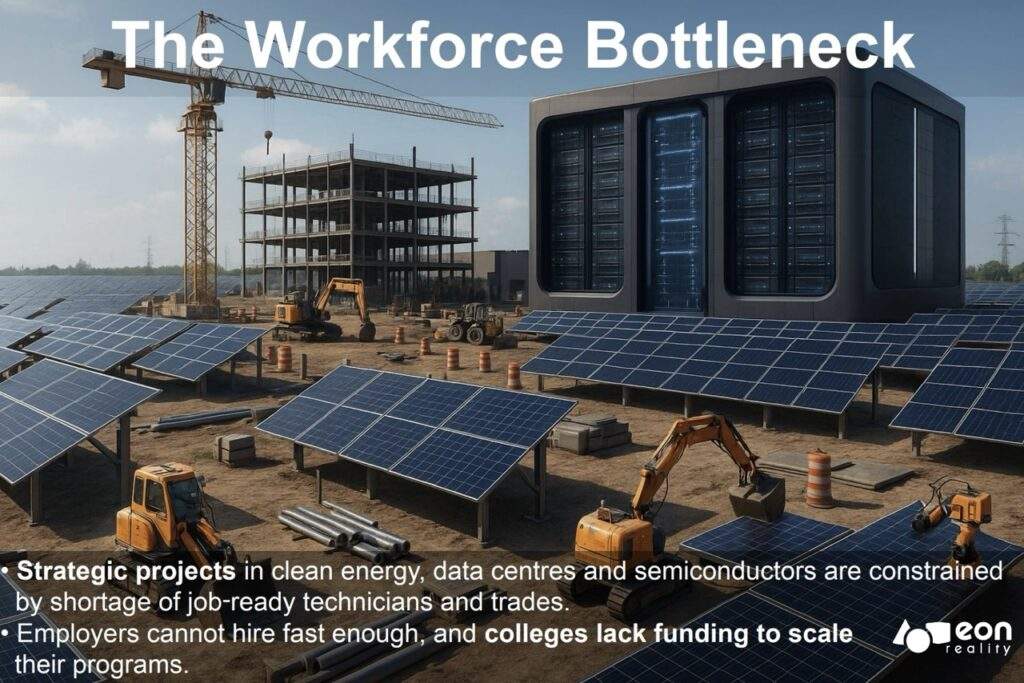
A ring-fenced, regional vehicle that fronts all-in training capacity—XR devices/labs, Virtual Campus licenses, content bundles, mobile labs, and train-the-trainer—coordinating multiple colleges and employers under one governance and reporting umbrella. Colleges do not take new debt.
Repayment design: diversified, contract-anchored inflows—employer take-or-pay seats, WIOA ITAs via ETPL programs, outcomes-based payments (placement/retention), plus targeted public grants—create predictable cash flows for debt service.
How it protects public dollars (controls & continuity)
- Trustee-managed waterfall: Revenues flow through controlled accounts; debt service is prioritized, reserves funded, and operating spend released under covenants.
- Five-tier security package: contracted revenues; hard assets (XR labs/devices, escrowed licenses); credit enhancers (grants/first-loss/LOCs); cash controls (escrows, DSRA); step-in rights for lenders.
- Continuity under stress: If a counterparty underperforms, lenders can replace the operator, assume contracts, and control labs/licenses—training continues and outcomes persist.
Illustrative NoVA case: Employer contracts (AWS + Dominion) ~1,000 seats/yr → $15M; ETPL ITAs $3–5M/yr; outcomes contract $2M/yr; $2M XR assets; $3M DOL + $1M first-loss; escrow + 12-month DSRA. Result: resilience if any single stream falters.
Compliance & accountability built-in
- WIOA/ETPL operations with audit-ready documentation; apprenticeship standards and FERPA aligned; outcome dashboards for public funders.
- Integrity Suite replaces vulnerable written work with performance-based assessments (XR procedures, decision sims, oral defenses) and telemetry—evidence accreditors and auditors can trust.
- Legal & Compliance Checklist includes ETPL eligibility, Registered Apprenticeship mapping (OJT/RTI), safety/industry standards (OSHA/NCCER/NIMS/ISO), privacy (FERPA), and third-party verification.
What public agencies get (policy outcomes)
- Documented ROI: time-to-competency, pass/retention, placement ≤90 days, 12-month retention, wage uplift; quarterly public dashboards and lender packs (utilization, DSCR).
- Equity & rural access: mobile-first, offline-capable delivery and mobile XR labs to reach underserved communities; ESG/CRA alignment.
- No new college debt: SPV is the borrower; colleges remain provider of record under the Collaboration Agreement.
The Hybrid Model: Bankable finance + inclusive governance
- SPV backbone for clean underwriting; Collaboration Agreement (MOU) for stakeholder ownership without gridlock. Agencies and workforce boards are signatories, shaping demand forecasts, outcomes triggers, and equity targets while avoiding debt exposure.
- Program oversight: independent board and trustee; program auditors verify placement/retention and apprenticeship compliance; transparent dashboards report utilization, placement, wage uplift, and DSCR.
Comparison: Traditional Grant-Funded Pilots vs. SkillBuild SPV (Public Track)
| Dimension | Traditional Pilots | SkillBuild SPV |
| Funding Source | One-off grants; renewal risk | Multi-payer inflows (offtake, WIOA/ETPL, outcomes, grants) |
| Financial Controls | Departmental budgeting | Trustee waterfall, escrows, DSRA, covenants |
| Continuity If a Partner Falters | High program stoppage risk | Lender step-in keeps training running |
| Evidence for Audits | Text-based, inconsistent | Performance telemetry + oral defenses with audit bundles |
| Equity & Reach | Fixed sites | Mobile labs, offline-capable delivery |
| College Balance Sheet | Often requires capex | No new college debt; SPV is borrower |
Citations: inflows & waterfall; step-in rights; integrity stack; mobile/equity; no new debt.
90-Day clock-speed plan (what agencies can expect)
- Days 0–15 — Commit & light up: draft outcomes triggers with WDB; Generic Virtual Campus live; strands identified; employer LOIs collected.
- Days 16–45 — Localize & contract: Premium modules from SOPs; faculty approve-to-deploy; outcomes/MOU drafts complete; diligence room (waterfall, reserves, asset list, dashboards) populated.
- Days 46–90 — Close & launch: close SPV (senior + catalytic + first-loss); procure devices/mobile labs; train-the-trainer; start first cohorts and publish dashboards.
Regions & partners (initial focus)
Northern Virginia (data-center nexus), Phoenix (TSMC), Central Ohio (Intel), San Antonio/DFW (grid/DC expansion), Syracuse/Clay, NY (Micron). Each “regional pack” includes demand indicators, hiring targets, travel-time rings for mobile labs, and named college partners.
KPIs public funders and boards track
- Time-to-competency, pass/retention, placement ≤90 days, 12-month retention, wage uplift.
- Seat utilization & apprenticeship fulfillment; employer offtake delivery.
- DSCR and covenant compliance at the SPV level; quarterly transparency packs.
What we ask from Workforce Boards & Agencies
- Execute outcomes contracts tied to placement, 12-month retention, and wage uplift triggers; recognize Virtual Campus evidence for ETPL/audit and public dashboards.
- Target grants where they de-risk leverage and accelerate seat creation (catalytic or subordinated layers).
- Set equity targets and rural delivery expectations; monitor via quarterly dashboards.
For a deeper dive into EON SkillBuild, access the full white paper: EON SkillBuild SPV: Bankable Workforce Transformation for the AI Era.
Learn more by tuning to our podcast.
About EON Reality
EON Reality is the world leader in AI-assisted Augmented and Virtual Reality-based knowledge transfer solutions for education and industry. With over 25 years of experience and a global presence across six continents, EON Reality has pioneered innovative technologies including the EON-XR platform, AI-powered learning frameworks, and immersive training solutions. The company is dedicated to making knowledge accessible worldwide through cutting-edge technology, serving millions of learners across educational institutions and enterprises globally. For more information, visit www.eonreality.com