IRVINE, CA – April 20, 2026 – EON Reality, together with EON AI Ventures, today announced the formal introduction of the EON AI Fluency Theory, a first-of-its-kind framework that defines the structural divide emerging in the global workforce as a result of artificial intelligence. As AI systems evolve into autonomous, token-driven economies, this theory outlines a fundamental shift in how value is created, distributed, and sustained across industries.
Accompanying the announcement is the activation of EON’s AI Fluency Segment (Segment 18)—a structured learning pathway consisting of 100 courses across five proficiency levels, delivered through the EON Global Virtual Campus. This initiative provides individuals with a scalable and accessible route to achieving AI Fluency, positioning them to actively participate in and benefit from the rapidly expanding token-based economy. At its core, the EON AI Fluency Theory asserts that the workforce is divided into two distinct groups: those who leverage AI to multiply their value as builders, and those whose roles are increasingly automated by intelligent systems—making AI Fluency not just a competitive advantage, but a fundamental requirement for participation. The conceptual framework, economic implications, and learning architecture behind this theory are detailed in the accompanying white paper, “The Token Economy and the EON AI Fluency Theory.”
The Evidence: Five Converging Data Streams
The EON AI Fluency Theory does not rest on projections or conjecture. Five independent data streams, all published in March 2026, converge on the same structural conclusion:
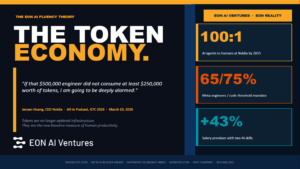
- Nvidia / GTC 2026: Nvidia CEO Jensen Huang stated at GTC 2026: “If that $500,000 engineer did not consume at least $250,000 worth of tokens, I am going to be deeply alarmed.” Huang announced plans to pay engineers token budgets worth approximately half their base salary as a standard compensation element. Nvidia projects a future workforce of 75,000 human employees alongside 7.5 million AI agents — a ratio of 100 digital workers per human.
- Meta Leaked Memo: Meta’s leaked internal memo reveals the company is restructuring its entire Reality Labs engineering division into AI Builder pods. Every employee holds one of three titles: AI Builder, AI Pod Lead, or AI Org Lead. A separate internal document mandates that 65% of Meta’s engineers use AI to generate 75%+ of their committed code — population target and usage threshold as a single combined mandate, tied to performance reviews and promotions. Meta has committed $135 billion to AI infrastructure in 2026.
- Anthropic Economic Index: Anthropic’s Economic Index ‘Learning Curves’ report, based on analysis of over 1 million real conversations, established that experienced AI users achieve a 10% higher success rate than newcomers — and that the gap widens with time. This is not a static divide. It is a compounding advantage that separates AI Builders from non-fluent workers every week it goes unaddressed.
- Monster.com / Fast Company: Monster.com data shows AI skills on resumes tripled between 2023 and 2025 — from 3.7% to 12.8%. The term ‘artificial intelligence’ on resumes surged from 0.5% to 6.3%. Fast Company reports that jobs requiring one AI skill pay 28% more; jobs requiring two AI skills command a 43% salary premium. The labour market has already priced in AI fluency — before most institutions have begun teaching it.
- Resume.org / Layoffs.fyi: Resume.org survey data shows 55% of U.S. companies plan layoffs in 2026, with 44% citing AI as the primary driver. 71 technology companies have already conducted layoffs affecting over 40,000 employees in early 2026. Entry-level roles — the traditional workforce entry point — face the greatest displacement risk.
The EON Response: AI Fluency Segment and Global Virtual Campus
EON Reality’s response to the Token Economy is the AI Fluency Segment (Segment 18) — the world’s first structured, immersive, career-connected curriculum specifically designed to move learners from passive AI users to verified AI Builders. The Segment comprises 100 courses across five proficiency groups:
- Group A — AI Awareness: 20 courses covering the foundations of AI fluency — from AI consumer to informed user, establishing the baseline every professional now requires.
- Group B — AI Collaboration: 20 courses developing the skills to work with AI as a genuine thought partner, stress-tester, and co-creator rather than a simple task automation tool.
- Group C — AI Orchestration: 20 courses focused on managing AI agents, deploying token budgets strategically, and orchestrating multi-step AI workflows — the core AI Builder competency set.
- Group D — AI Leadership: 20 courses covering the design of AI-native teams, AI Builder pod structures, and organisational AI usage standards — the leadership layer Meta is building from the top down.
- Group E — AI Architecture: 20 courses on designing AI-native workflows at institutional scale, selecting and integrating large language models, measuring token ROI, and building systemic AI fluency infrastructure.
Segment 18 is delivered through the EON Global Virtual Campus platform — combining XR immersive simulation environments, Brainy Socratic AI Tutor 2.0 (persistent memory, emotional intelligence, adaptive instruction), multi-avatar soft skills simulation, and EON Career Compass™ (live job market data connecting AI Builder credentials directly to employment paying the 28–43% salary premium). Deployment takes 30 days. Financing through EON’s ImpactShare model requires 1% upfront with zero capital expenditure.
Click on the image below to access the EON Token Economy presentation.
Quotes
| “The Token Economy is not a future scenario. It is the operating reality of every major technology company today. Jensen Huang has named the standard. Meta has built the org chart. Anthropic has measured the performance gap. EON has built the curriculum that closes it. AI Fluency is not a skill. It is the price of admission — and we have built the gateways,” said Dan Lejerskar, Founder & Chairman, EON Reality & EON AI Ventures. |
| “Every institution — university, enterprise, government — that does not have a structured AI Builder program by 2027 will be in the position of an organisation that didn’t have internet access in 2002. The window to act proactively, rather than reactively, is open right now. EON’s Segment 18 is the only structured, immersive path that connects AI fluency training directly to employment outcomes,” stated Mats Johansson, President, EON Reality. |
Read more in the “The Token Economy and the EON AI Fluency Theory.” white paper.
Learn more by tuning to our podcast.
About EON Reality
EON Reality, based in Irvine, California, is the world’s leading company in immersive learning and knowledge transfer. Its flagship solutions — EON-XR, EON AI Assistant, and AI² Creator — enable millions of users to create and deploy experiential learning content. EON Reality’s mission is to make knowledge available, accessible, and affordable globally. For more information, visit www.eonreality.com