IRVINE, CA — February 19, 2026 – EON Reality, together with EON AI Ventures, is proud to unveil the AI-Native Children’s Hospital, a revolutionary vision for pediatric healthcare powered by Generative AI, Spatial Computing, and Adaptive AI Mentors. This cutting-edge approach confronts longstanding challenges in pediatric care, such as high sedation rates for MRIs and unsafe post-discharge transitions, with transformational technologies that deliver measurable clinical and operational improvements.
Designed to eliminate critical gaps in the pediatric journey — from reducing reliance on sedation during imaging to empowering parent caregivers at home — the AI-Native Children’s Hospital integrates interactive 3D environments and AI-native immersive experiences into every touchpoint. The result is a healthcare delivery model with the potential to redefine safety, competency, and efficiency standards for pediatric systems worldwide. The vision, system architecture, and real-world impact of this approach are explored in depth in the accompanying white paper, “The AI-Native Children’s Hospital: AI-Native Hospitals — Revolutionizing Pediatric Care with Generative AI and Spatial Computing.”
The Crisis We Solve
| Metric | Value |
| MRI-related sedation rate for children <6 | 66.2% |
| Adverse events during sedation | Up to 64.4% |
| Preventable pediatric readmission rates | 30–79% |
| 30-day unplanned pediatric readmission | 5–7% |
THE WHY: Gaps in Pediatric Safety and Experience
Pediatric healthcare faces challenges that conventional tools and workflows cannot resolve. For MRI procedures vital to diagnosing neurological, cardiac, and oncological conditions in children, the necessity of sedation for patients under six is a clinical and operational crisis. Studies show that 66.2% of MRI sedations involve children aged five or younger, placing them at risk of neurocognitive concerns cited in the FDA’s 2019 safety communication. For health systems, sedation also entails resource strain, consuming 2–4 hours of clinician and equipment time per case—a costly inefficiency when multiplied across hospitals conducting 750 or more MRIs per month.
The problem compounds post-discharge for medically complex children. Parents tasked with managing tracheostomies, central lines, or complex medication regimens face alarming levels of preventable error, contributing to pediatric readmission rates of 5–7% within 30 days. Evidence shows that up to 79% of readmissions in this group are preventable with better discharge education, training, and follow-up strategies.
These gaps in preclinical preparation and post-discharge safety demand a new standard of pediatric care—one that combines real-time interactivity with adaptive learning to tackle these challenges head-on.
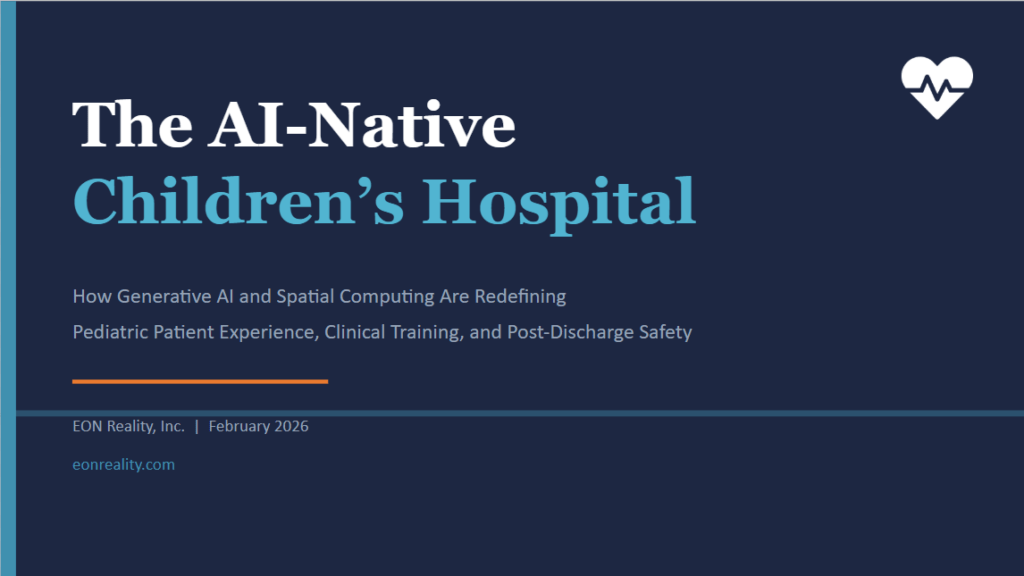
Click on the image below to access the full EON Product presentation.
The Challenge
Until now, healthcare has been reliant on tools that cannot evolve to meet this complexity. Static discharge instructions fall short for panicked parents administering medical procedures at home. Traditional imaging workflows cannot eliminate sedation risks without groundbreaking alternatives for pediatric engagement.
As the clinical need grows, the technology exists to meet it: Generative AI, Spatial Computing, and adaptive mentorship capabilities are disrupting what is possible in healthcare environments. It is no longer acceptable to wait.
THE WHAT: The AI-Native Children’s Hospital
The AI-Native Children’s Hospital is much more than a set of technologies. It is a paradigm shift in how pediatric healthcare can and should be delivered, leveraging Generative AI and Spatial Computing to create responsive, immersive, and intelligent interactions throughout the continuum of care. With the introduction of Sentient Architecture, hospitals can design environments that feel alive—tailoring responses to each child’s emotional state, age, clinical need, and language preferences.
Pioneering capabilities like Generative Worlds allow hospitals to create hyper-realistic, interactive 3D environments in minutes. This enables pediatric patients to participate in MRI “practice sessions” within virtual replicas of scanner rooms, significantly reducing sedation rates while empowering families with preparation tools. Meanwhile, Adaptive AI Mentors provide personalized guidance, simulating the presence of a clinician to ensure skill retention and correct technique for post-discharge care.
This system isn’t just a vision—it’s actionable, scalable, and rooted in measurable results for both patients and healthcare systems.
KEY FEATURES
1. Generative Worlds: Immersive Care Settings
- Create fully interactive 3D environments in under 10 minutes.
- Minimize the need for sedation by simulating MRI preparation experiences.
- Foster patient understanding and emotional comfort in clinical settings.
2. Adaptive AI Mentors
- Personalize guidance for children and caregivers based on age, emotional state, and clinical situation.
- Provide real-time corrective feedback for home procedures like medication administration or tracheostomy care.
- Enhance retention of discharge education to support safer transitions to home environments.
3. Sentient Architecture
- Design hospital spaces augmented by intelligent systems that adapt to individual needs.
- Leverage AR/VR for interactive engagement during high-stress situations.
- Extend beyond static XR with AI-native immersive experiences that increase clinical utility.
IMPLEMENTATION
Transforming a traditional pediatric facility into an AI-Native Children’s Hospital requires a phased approach rooted in collaboration with clinical teams, IT departments, and leadership stakeholders. Starting with MRI prep rooms and post-discharge education modules, an 8–12 week implementation period prepares health systems to rapidly scale up.
Hospitals leveraging this model reclaim caregiver time, reduce adverse sedation events, and empower more parents to deliver competent home care—all while dramatically improving patient satisfaction and operational efficiency.
Read more in the The AI-Native Children’s Hospital: AI-Native Hospitals — Revolutionizing Pediatric Care with Generative AI and Spatial Computing” white paper.
Learn more by tuning to our podcast.
About EON Reality
EON Reality is the world leader in AI-assisted Augmented and Virtual Reality-based knowledge transfer solutions for education and industry. With over 25 years of experience and a global presence across six continents, EON Reality has pioneered innovative technologies including the EON-XR platform, AI-powered learning frameworks, and immersive training solutions. The company is dedicated to making knowledge accessible worldwide through cutting-edge technology, serving millions of learners across educational institutions and enterprises globally. For more information, visit www.eonreality.com