IRVINE, CA and SINGAPORE — The release of DeepSeek V4 in April 2026 by the Chinese AI lab DeepSeek is the clearest market signal yet that the foundational assumption underwriting more than one trillion dollars of US AI capital expenditure — that three or four frontier labs would corner the highest intelligence and extract rent from everyone else — is no longer reliable. V4 is a 1.6-trillion-parameter open-source model with 49 billion active parameters using a Mixture-of-Experts architecture. It performs at near-frontier level on math, coding, and reasoning. It runs at roughly one tenth the cost of US-based equivalents. The capability gap that was supposed to be measured in years is now measured in months. The thesis that intelligence would be a scarce, premium-priced product has just been falsified in public.
Today EON Reality formally declares this the Linux Moment for artificial intelligence — the moment at which the substrate of the technology stops being owned by a small number of vendors and becomes the free, distributed foundation on which everyone else builds. EON positions its Door 3 (Builder) Programme — a $975, 90-day, self-paced sprint — as the operational tool that turns the cost collapse of intelligence into ownership of an AI-native business. The substrate just got free. Door 3 is what packages it into income.
The Real Shift: Two Futures Just Collapsed Into One
For two years the AI capital cycle has been priced on a single bet — that a small number of US frontier labs would sustain a ten-times capability moat over everyone else, vertically integrate down the stack, and absorb the application layer (PowerPoint, CRM, document tools, the broader SaaS economy) into the model itself. EON has internally referred to this as the Three Towers scenario. Under Three Towers, returns flow to the model owners and distribution becomes a thin reseller layer.
The competing scenario — Thousand Gardens — holds that open-source models, particularly those originating from Chinese labs operating under US chip export restrictions, would compensate through algorithmic innovation and drive the cost of useful intelligence toward zero. Under Thousand Gardens, frontier-grade intelligence becomes a luxury good reserved for defense and the top one percent of proprietary work, and returns flow to whoever owns distribution and packages the substrate into vertical, country-specific, customer-trained solutions.
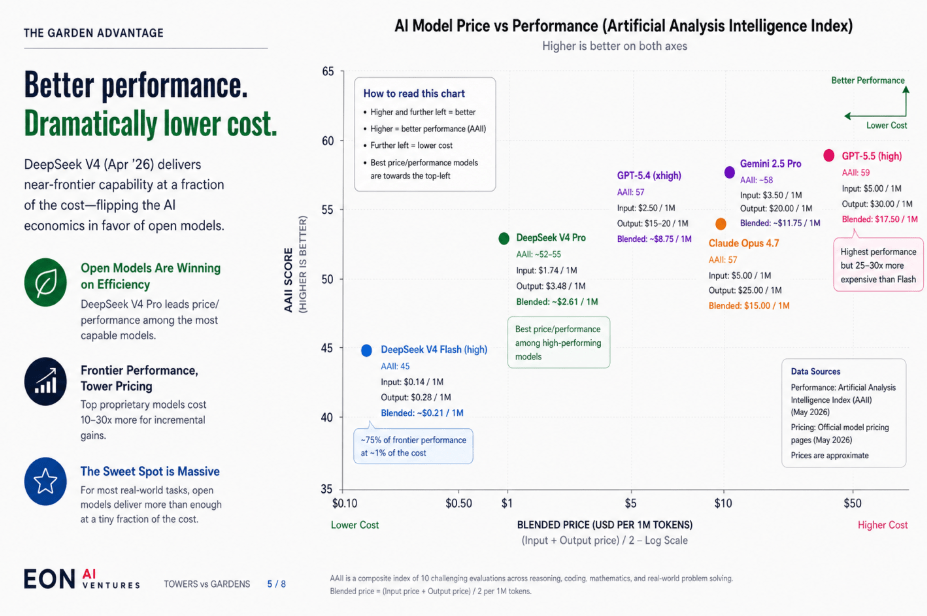
DeepSeek V4 is the data point that tilts the probability decisively toward Gardens. The four hard numbers that matter:
- 1.6 trillion parameters with 49 billion active. Open-source. Released without permission from any US lab.
- Roughly ten percent the operating cost of US frontier models for non-frontier workloads, which represent the majority of enterprise demand.
- Near-frontier performance on math, coding, and reasoning benchmarks. Not a toy. Not a research artifact. Production-grade.
- Months of moat, not years. The Towers thesis required a sustained ten-times capability gap. V4 demonstrated that the gap is measured in single-digit months.
This is the falsification of the bet. Not in theory. In benchmarks, in inference cost, in market response. The trillion dollars committed to the Towers outcome will, in the most likely case, instead accelerate the commoditization of the substrate underneath everything.
Why Waiting for the Towers to Open Is Not a Strategy
The trajectory of the US frontier labs is concentration, not diffusion. Anthropic has already geo-restricted its most advanced model from substantially all of Europe other than the United Kingdom. OpenAI, Anthropic, and Google have all introduced enterprise-tier pricing structures that systematically exclude the individual operator and the small business. The premise that frontier capability would eventually trickle down to everyone is not supported by the actual product decisions of the labs that hold it.
The diffusion is happening through a different door. It is happening through Chinese open-source releases that any developer in any country can download, fork, fine-tune, and deploy on commodity infrastructure. The cost collapse of intelligence is not being delivered by the labs that built the moat. It is being delivered by the labs that broke it.
This places every individual founder, every small business, every regional enterprise, and every government outside the small geography that owns the towers in a single position: the substrate is now free, but only the people who package it into a vertical, distribution-owned product will capture the value. That is the Builder role. That is Door 3.
Click on the image below to access the Shift Has Begun presentation.

What Door 3 Delivers: The Red Hat Layer for AI
In the Linux era, the operating system itself became free, but a small number of companies generated multi-billion-dollar businesses by packaging that free substrate into supported, vertical, enterprise-ready distributions. Red Hat is the canonical example. EON Door 3 is the equivalent layer for the AI economy: a productized, supported, vertically packaged distribution of free open-source intelligence, owned by the individual founder and sold under their own brand.
For $975 one-time, over 90 self-paced days, the Door 3 (Builder) participant receives the same five operational assets a Silicon Valley founder uses to operate in the AI economy:
- 250 AI Workers (your leverage). Two hundred and fifty proprietary agents running 24 hours a day on shared cloud compute, built on top of free open-source model substrate. The compute the data centers have. At your fingertips, not theirs.
- Brainy 2.0 AI Coach (your mentor). A personal AI mentor with real face and real voice, available any hour. The advisor SF founders have, available to anyone, anywhere.
- EON Marketplace (your distribution). 4,400-plus institutional buyers across 80-plus countries. The audience SF founders chase, already on the other side of your product.
- EAFI Credential (your proof). Tamper-resistant, employer-verifiable, public URL. The signal SF talent flashes, held by you, not your HR file.
- Distribution Engine (your pipeline). Customers surfaced automatically. The pipeline SF founders pay growth marketers for, built into the platform.
Door 3 specifically operationalizes five structural principles, each of which derives directly from the Linux Moment thesis:
- Agent Proprietorship. Two hundred and fifty agents, owned by the founder, generating revenue. Built on free substrate. Not licensed back from a tower.
- Open-source models as the engine. Open-source models (Chinese or US, whichever performs best for the workload) as the underlying intelligence. No rent paid to a frontier lab.
- Vertical packaging. Country-specific, language-specific, industry-specific. The substrate is generic. The package is not. The package is what the customer pays for.
- Train on the customer. The agent’s value is its embedded knowledge of one organization, one community, one workflow. Not transferable. Not commoditizable. Not replaceable by the next model release.
- Own the distribution. Direct relationship with the founder, the school, the enterprise, the government. The model layer never sees the customer. The Builder does.
The programme is backed by a four-condition money-back guarantee tracked objectively on the platform: complete the 100-course AI Fluency curriculum, attend twelve-plus mentor sessions, submit a Venture Builder spec by Day 45, and ship a live product URL by Day 90. If a participant meets all four conditions and has no paying customers, they get every dollar back. No subjective review. No trust-based promise. Platform-enforced.
The Convergence Wall
EON’s Door 3 thesis is not a contrarian bet. It is the operational distillation of a convergence of independent, dual-source signals across the AI industry, the financial press, the academic record, and the frontier labs themselves. The seven sources that, taken together, define the Linux Moment:
- DeepSeek V4 release (April 2026). 1.6T-parameter open-source model at roughly one-tenth US frontier cost. The signal that the moat is months wide, not years.
- Stanford 2026 AI Index. Documented order-of-magnitude collapse in inference cost across the frontier; the 88 percent / under-10 percent Agent Gap across organizations.
- Fortune (April 18, 2026). Sam Brown case study: $300,000 ARR in 12 weeks using an EON-style framework. The Builder model in the wild.
- Andreessen Horowitz / Fortune (April 15, 2026). Software moat compression from ten years to five weeks. The application layer is being eaten; the distribution layer is where value moves.
- Inc. Magazine (April 15 and April 20, 2026). “Slowly, then real fast” framing of the AI labour transition; the contrarian thesis that the few who learn to deploy agents win regardless of displacement timing.
- Moonshots Episode #249 (April 23, 2026). Diamandis, Ismail, Blundin, and Wissner-Gross on the record: “We need a plan for a country of non-geniuses outside the data center.” The industry’s own confession that no plan exists at the institutional level.
- TOP500 Supercomputer List (since November 2017). 100 percent of the world’s most powerful supercomputers run Linux. The historical proof that, when the substrate goes free, the substrate wins.
Six of those seven sources document the AI transition. The seventh provides the historical template for what happens next. Across all seven, the convergence is no longer a thesis. It is a documented operational reality, and Door 3 is the individual-scale instrument built to capture it.
What This Means for Real People
Door 3 is built specifically for the individual who refuses to wait for the towers to open and refuses to settle for the joiner role inside an existing employer. The audiences who benefit most:
- The laid-off knowledge worker staring at severance and a LinkedIn feed full of ghosted applications. In 90 days, ownership of an AI-native business at $975, not a re-entry into the queue.
- The skilled professional with a vertical insight — a doctor who knows what diagnostic agents their specialty needs, a lawyer who knows what their practice area’s bottleneck is, an educator who knows what their classroom is missing. Door 3 turns the insight into a packaged product, owned by them, sold to their peers.
- The student or recent graduate facing a labour market where entry-level AI-augmented roles are disappearing. Skip the broken ladder. Start as a Builder on Day 1, not Year 5.
- The parent who wants to show their children what to do, not just tell them to study hard and hope. A concrete, demonstrable, inheritable path to ownership in the AI economy.
- The founder in any country outside Silicon Valley — every regional entrepreneur whose government has correctly identified that sovereign AI capability cannot be rented from a US tower in perpetuity. The Builder programme is the individual instrument; the EON Government Garden license is the institutional one.
- The community or government facing large displaced populations and no AI-native reskilling instrument that operates at AI-era speed. Door 3 deploys in 90 days, not five-year policy cycles.
Statement from EON AI Ventures
Dan Lejerskar, Founder and Chairman of EON Reality and EON AI Ventures, on the launch:
“DeepSeek V4 did not just release a model. It released the substrate. The trillion dollars chasing the Towers outcome will, on the most likely path, accelerate the commoditization of the very thing it was supposed to monopolize. That is the Linux Moment for AI, and it has already begun. EON has spent two years building Door 3 for this exact moment. For $975, in 90 days, we hand the individual founder the five operational assets a Silicon Valley founder uses, packaged on top of the same free open-source substrate that just got cheaper this month. The opportunity didn’t get smaller. It just got cheaper to enter. And the window will not stay this wide forever.”
How to Enroll
- Enrolment: ohwow.ai/founder — open now, no approval required, self-paced.
- Price: $975 one-time, with the four-condition money-back guarantee.
- Duration: 90 days self-paced. Start any day. Pause and resume as needed.
- Institutional partnerships: [email protected]. Activation fees $50,000 to $200,000 depending on cohort scale. Sovereign Garden licenses available for governments and regional consortia.
- Accompanying briefing deck: “The Shift: DeepSeek V4 and the Linux Moment for AI” — seven slides documenting the cost collapse, the Towers vs Gardens framing, and EON’s Red Hat positioning. Available to partners, press, and prospective participants on request.
Learn more by tuning to our podcast.
About EON Reality
EON Reality, based in Irvine, California, is the world’s leading company in immersive learning and knowledge transfer. Its flagship solutions — EON-XR, EON AI Assistant, and AI² Creator — enable millions of users to create and deploy experiential learning content. EON Reality’s mission is to make knowledge available, accessible, and affordable globally. For more information, visit www.eonreality.com