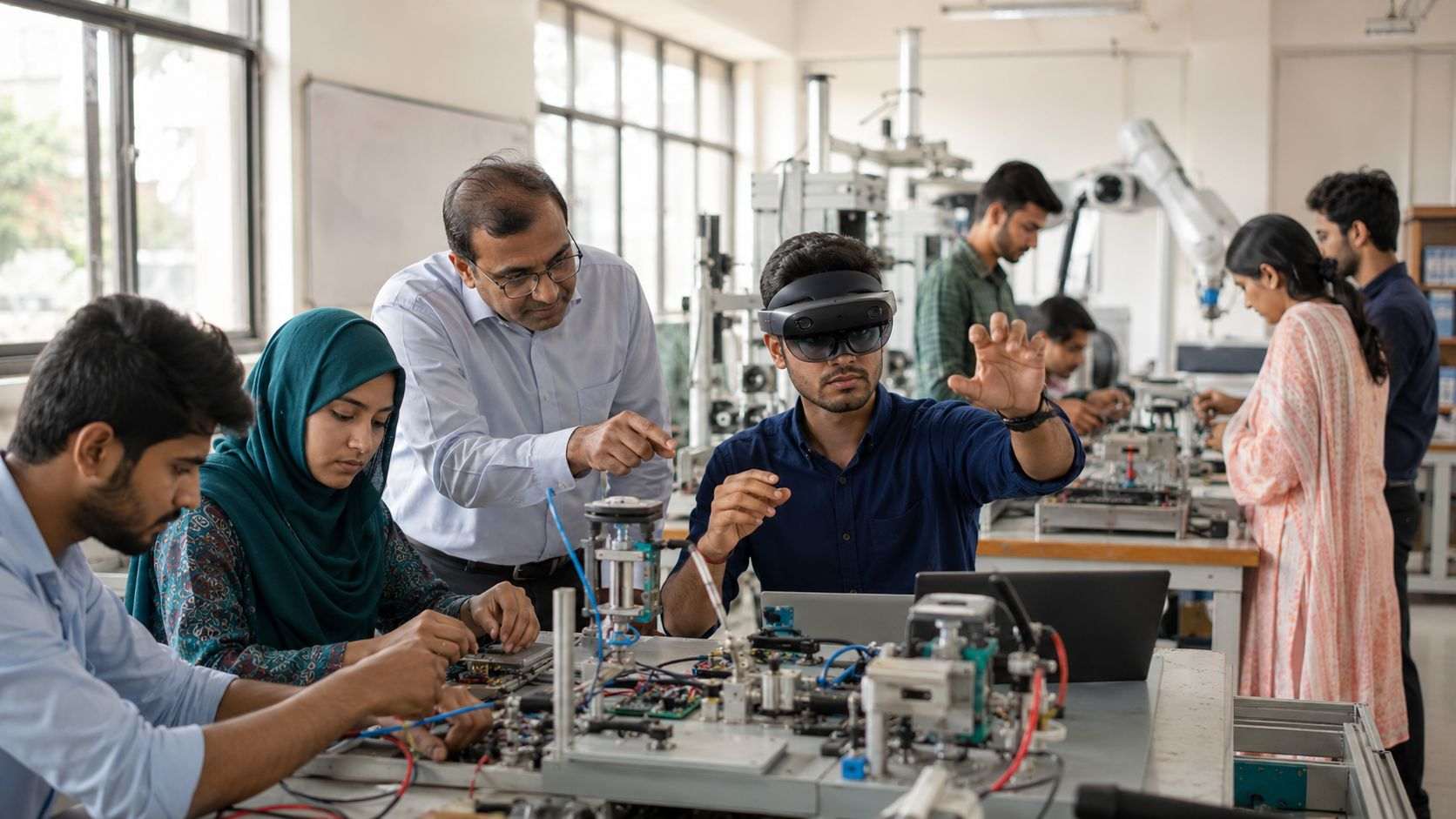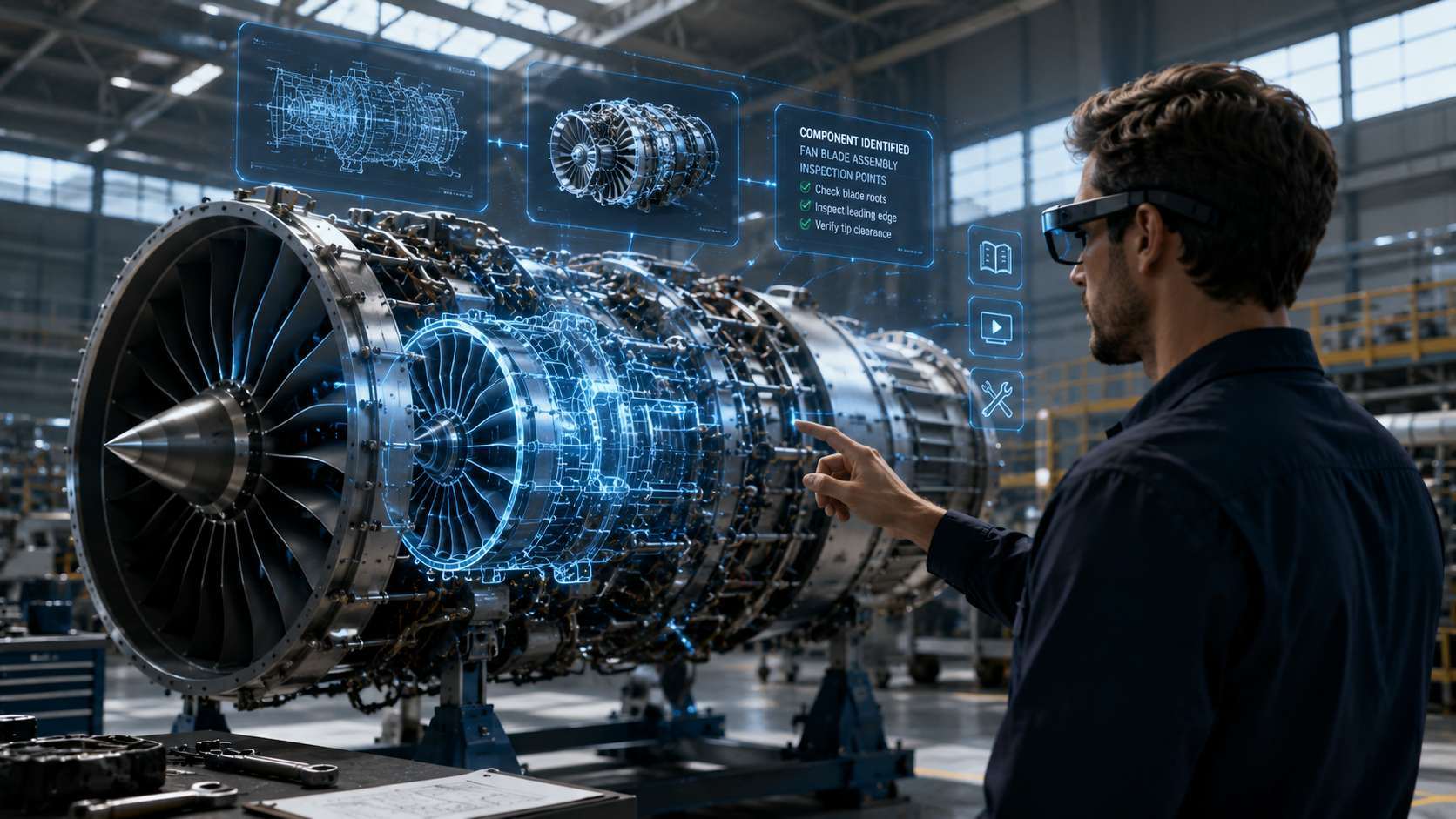
IRVINE, CALIFORNIA — April 2026 — EON Reality today announces the launch of Genesis 3.0, an AI-powered XR training simulator that redefines how enterprise training is created and delivered. Designed for high-stakes industries including energy, aerospace, healthcare, and manufacturing, the platform enables subject matter experts to build fully interactive, physics-based training simulations in as little as five minutes—using simple, natural language descriptions.
At the core of this innovation is Describe & Wire, a breakthrough interaction authoring system that eliminates the need for complex coding, specialized 3D development teams, and lengthy production cycles. By combining AI-driven learning with immersive simulation environments, EON Reality empowers organizations to accelerate training deployment while ensuring real-world readiness and precision.
The full platform architecture, implementation framework, and industry impact are detailed in the accompanying white paper, “Revolutionizing Training: Build Physics-Based XR Simulations in Minutes with Plain English AI”.
The Crisis We Solve
| Metric | Value |
| Time to create a typical XR module | 6–12 months |
| Cost of traditional XR training projects | $50,000–$150,000 per module |
| Time to create a module with Genesis 3.0 | 5 minutes |
| Average workforce retirement timeline | 50% in 5–7 years |
THE WHY: Revolutionizing Enterprise Training
In high-stakes industries, where even minor errors can lead to catastrophic outcomes, the current training methodologies have glaring limitations. Enterprise XR training often requires months of development and six-figure investments by multi-disciplinary teams, only to produce generic, animation-based experiences with limited interactivity. The absence of physics-based consequences in these modules means trainees miss opportunities to develop muscle memory and procedural proficiency—both critical for real-world scenarios.
Safety, efficiency, and knowledge retention are at the forefront of industry concerns. As 50% of industry experts approach retirement within the next five to seven years, the transfer of institutional knowledge becomes crucial. Current training approaches not only fail to prepare new employees effectively but also struggle to capture—and standardize—the expertise of seasoned professionals.
These outdated methods perpetuate disconnection, leaving enterprises ill-equipped to meet the demands of modern operations. Industries urgently need a way to deliver personalized, high-fidelity training experiences that bridge the gap between theoretical knowledge and hands-on proficiency.
Click on the image below to access the Genesis 3.0 Complete Deck presentation.
The Challenge
Traditional XR training development involves prohibitively high costs, elongated timelines, and technical barriers. For organizations operating in environments where precision, safety, and compliance are mission-critical, these inefficiencies aren’t just costly—they’re dangerous. An effective solution must deliver nuanced, real-world physics, while breaking from resource-intensive practices that make XR training inaccessible to all but the largest enterprises.
THE WHAT: Genesis 3.0
Enter Genesis 3.0, a game-changing AI platform designed to democratize XR simulation development. Leveraging natural language as its foundation, the platform empowers subject matter experts to create physics-based training simulations within minutes—no coding skills, 3D expertise, or expensive software installations required.
At the core of this innovation is its proprietary Describe & Wire technology, which allows trainers to input simple sentences like, “If the trainee adjusts the blue lever, the conveyor belt moves, and the red warning light activates.” The integrated AI parser instantly interprets these instructions, mapping 3D objects, actions, and physics-driven effects in real time. This eliminates the need for traditional development pipelines, which often involve months of collaborative work by 3D modelers, programmers, and instructional designers.
Through Genesis 3.0, trainers can build immersive training scenarios directly in any web browser. The platform reduces overhead and complexity while enabling measurable outcomes such as faster time-to-competency, improved knowledge retention, and enhanced safety.
Key Capabilities
Describe & Wire
- A first-of-its-kind natural-language interaction authoring system.
- Simplifies scenario creation: describe actions, and let the AI handle object identification, event mapping, and rule generation.
- No coding, no 3D modeling, and no cloud processing required.
Real-Time Havok Physics
- Simulations feature authentic physics such as mass, gravity, and restitution.
- Trainees experience a consequence-driven learning environment, mirroring real-world physical behaviors.
- A constraint graph enforces procedural accuracy by requiring tasks to be completed in the correct sequence.
Four-Phase Training Loop
- Show Me: Demonstrate proper procedures.
- Guide Me: Provide interactive, step-by-step coaching.
- Let Me Try: Encourage hands-on learning and application.
- Evaluate Me: Assess skills for certification.
- Ensures trainees advance from observation to proficiency systematically.
AI Avatar Guide System
Three guidance options allow for diverse use cases:
- Mixamo Avatar for physical demonstrations.
- HeyGen Avatar for realistic, lip-synced instructions.
- Drone Guide, a laser-pointing assistant for streamlined direction.
Universal XR Support
- Compatible with leading XR devices such as Meta Quest 3, Pico 4, Microsoft HoloLens 2, and mobile platforms using ARKit, LiDAR, WebXR, and ARCore.
- Entirely browser-based with no installation required, reducing IT bottlenecks.
IMPLEMENTATION
Deploying Genesis 3.0 is frictionless, requiring only a web browser and a connected device. Trainers can upload standard 3D models in GLB format and proceed through the platform’s five-layer pipeline:
- 3D World (0:00): Upload the 3D model, with the AI completing annotation in under 10 seconds.
- Procedure (0:30): Automatically generate or upload procedural instructions.
- Recipe (1:00): Use pre-built templates to standardize and speed up recurrent training routines.
- Mission (2:00): Assign steps, integrate physics-driven hazards, and define event rules.
- Training (5:00): Conduct sessions featuring physics-based consequences and experience-driven evaluations.
Within just five minutes, organizations can build a fully interactive, certified training experience optimized for their workforce.
“Genesis 3.0 shatters the barriers of cost, time, and complexity in XR training development. By putting the power of physics-based simulation into the hands of subject matter experts, we are not just digitizing workflows—we are redefining what it means to train in high-stakes industries.”— stated Dan Lejerskar, Chairman, EON Reality.
Read more in the “Revolutionizing Training: Build Physics-Based XR Simulations in Minutes with Plain English AI” white paper.
Learn more by tuning to our podcast.
About EON Reality
EON Reality, based in Irvine, California, is the world’s leading company in immersive learning and knowledge transfer. Its flagship solutions — EON-XR, EON AI Assistant, and AI² Creator — enable millions of users to create and deploy experiential learning content. EON Reality’s mission is to make knowledge available, accessible, and affordable globally. For more information, visit www.eonreality.com