Irvine, CA – May 4, 2026 – EON Reality, together with EON AI Ventures is today formally positioning its two-stage learning architecture as the consumer AI-training model aligned with new empirical evidence challenging one of the market’s dominant assumptions: that anyone can become productive with AI through prompt-engineering training alone.
A field experiment published in Fortune on May 1, 2026, conducted by researchers from Harvard Business School, Stanford University, and the Stanford Digital Economy Lab at IG, a UK fintech company, found that professionals working outside their core domain and equipped with identical AI tools produced materially worse output than similar workers using no AI at all. The issue was not the AI technology. It was the absence of foundational domain knowledge.
Without that domain grounding, participants revised AI-generated work in ways that systematically weakened it, including removing valuable marketing language, shortening SEO copy, and eliminating calls to action. The researchers framed the finding as a structural constraint on who can deploy GenAI productively and who cannot. EON AI Ventures refers to this constraint as the “GenAI Wall.”
EON AI Ventures’ two-stage architecture directly addresses this challenge: 9,000 vertical-domain courses delivered through the Global Virtual Campus, followed by a 100-course AI Fluency curriculum layered on top. Designed years before the field experiment was conducted, the model now has empirical support for its core sequence: domain knowledge first, AI fluency second. One plus one equals ten.
What the Experiment Actually Found
The IG experiment tested three groups against a marketing task. The insiders — web analysts native to the work — served as the baseline. The adjacent outsiders — marketing specialists with shared domain vocabulary but not the specific task — used GenAI tools and passed through. With AI on top of adjacent domain knowledge, they were indistinguishable from the insiders. The distant outsiders — data scientists and software developers, technically AI-proficient but with no marketing knowledge — used the identical tools and hit the wall. Their AI-assisted output was empirically worse than the no-AI control. The variable that determined the outcome was not AI access. It was foundational domain knowledge that allowed the human to evaluate AI output before shipping it.
The implication is structural and is not softened by more training, better prompts, or more capable models. If the human cannot tell good output from bad in the relevant domain, the AI layer compounds the error. The wall is not a question of access to intelligence. The wall is a question of the human’s capacity to evaluate intelligence — and that capacity requires domain expertise that has to be acquired, not prompted.
Why Most Consumer AI-Training Programs Hit the Wall
The Harvard and Stanford finding is empirically devastating to the entire “learn AI to do anything” category. The competitive consumer AI-training market — Coursera AI tracks, Udemy AI bootcamps, McKinsey Academy AI fluency, the various foundation-model labs’ enterprise courses, and the bulk of corporate AI training — ships only what the experiment calls Stage 2: prompt engineering, model literacy, agent operations. None of these programs ships a foundational domain layer underneath. They sell AI capability detached from any specific vertical in which the participant is being trained to evaluate output. That is the configuration the experiment shows produces the failure case. Distant outsider plus AI tooling, hitting the wall, output worse than no AI at all.
The competitors do not fail because their AI training is bad. They fail because there is no domain layer beneath it. The wall is not a marketing problem they can fix with better landing pages. It is a structural problem with their product architecture, and it is now documented in Fortune by researchers from two of the most cited business schools in the world.
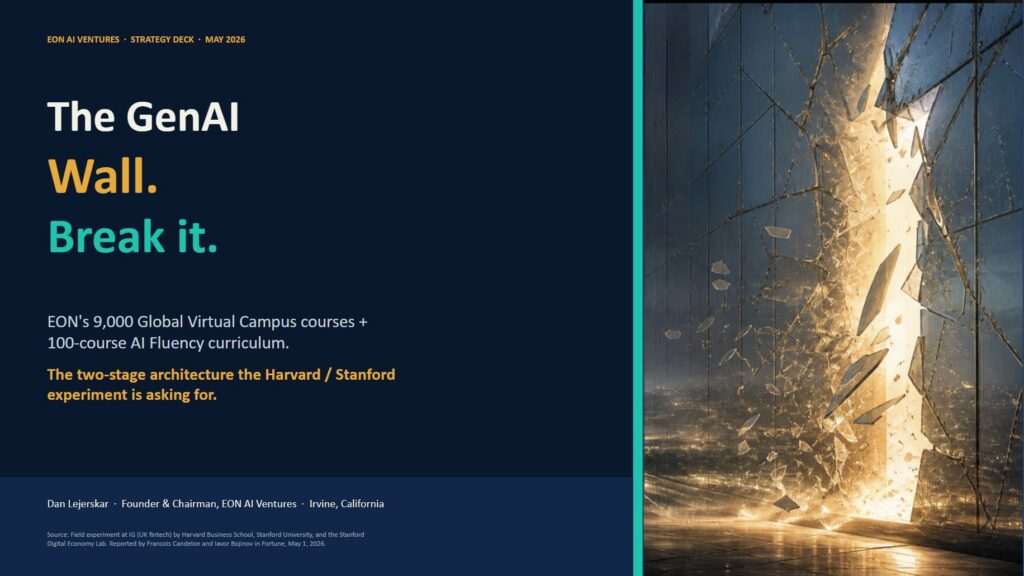
Click on the image below to access the GenAI Wall presentation.
EON’s Two-Stage Architecture: The Sequence That Breaks the Wall
EON’s consumer-facing program is built as a sequence, not as separate offerings. It maps directly onto the experiment’s pass-through condition.
- Stage 1 — Foundational Domain. Nine thousand vertical-domain courses across the Global Virtual Campus, spanning electric vehicles, energy, healthcare, hospitality, manufacturing, finance, education, agriculture, construction, logistics, and more. The participant acquires the domain knowledge — the taste — that lets them evaluate AI output in their chosen vertical. This is the layer no other consumer AI-training program ships. It is the moat.
- Stage 2 — AI Fluency, Layered on Domain. A 100-course AI Fluency curriculum organized as a three-level pyramid: Level 1 Consigliere (AI as advisor), Level 2 Agent (single-agent operations), Level 3 Product Builder (build and ship deployed product). Stage 2 is delivered on top of Stage 1, in that order, by design.
- Sequenced, Not Parallel. The architecture is the sequence. Stage 1 alone produces a domain expert without AI leverage. Stage 2 alone produces a distant outsider with AI tooling — the failure case the experiment documented. Stage 1 followed by Stage 2 produces the adjacent-outsider-with-AI condition the experiment shows is indistinguishable from the insider. One plus one equals ten.
Taken in order, the participant arrives at the AI deployment layer with the domain expertise that makes AI usable. Without Stage 1, Stage 2 is the wall. With Stage 1 underneath, Stage 2 is the breakthrough.
Two Use Cases. Same Architecture. Different Entry Points.
The two-stage sequence works for both directions of the AI labor transition.
- The graduate who cannot get the interview. Engineering or technical degree complete — foundational domain knowledge already established by the university. The graduate cannot pass the AI hiring filter because they have no demonstrated AI capability. The 90-day AI Fluency curriculum, layered on top of the existing degree, takes them to Level 3 (Product Builder). They ship a live product on the EON Marketplace, pass the AI filter, secure the interview, and walk in with deployed proof of capability rather than a résumé.
- The professional whose field has been absorbed. Translator, technical writer, journalist, mid-tier data analyst — occupations the AI cycle is in the process of consuming. Stage 1: acquire a new domain through the Global Virtual Campus (renewable energy, healthcare operations, advanced manufacturing, or another vertical of the participant’s choice). Stage 2: layer AI Fluency on top of the new domain. The participant becomes the adjacent outsider in the new vertical and passes through the wall — with operational capability in a field that is not being absorbed.
The Structural Indictment
Every other major consumer AI-training program on the market ships only Stage 2. Coursera ships AI courses with no domain anchor. Udemy ships AI bootcamps centered on prompt engineering. McKinsey Academy ships strategy-AI fluency without vertical depth. The frontier labs’ enterprise courses ship model literacy without a foundational domain layer. The bulk of corporate AI training is built on the “learn AI, do anything” promise the experiment now falsifies. EON is the only consumer AI-training program on the market that ships both stages, sequenced in the order the field experiment shows actually works.
Dan Lejerskar, Founder and Chairman of EON Reality and EON AI Ventures, on the announcement:
“Harvard Business School and Stanford have published the experiment that shows AI proficiency without domain expertise produces worse output than no AI at all. That is not a marketing claim. That is a finding. Every consumer AI-training program that ships only the AI layer — prompt engineering, model literacy, agent fluency — is now selling, in writing, the configuration the experiment shows produces the failure case. EON spent two decades building the 9,000-course Global Virtual Campus that becomes the foundational domain layer beneath AI Fluency. We did not build it for this experiment. The experiment validated, in public, the architecture we already shipped. The wall is structural. The sequence breaks it. One plus one is ten.”
On the Question of Endorsement
EON AI Ventures does not claim endorsement of its product by Harvard Business School, by Stanford University, by the Stanford Digital Economy Lab, by IG, or by the authors of the Fortune article. EON has not been in contact with the researchers. The complementarity between the field experiment and the EON two-stage architecture is structural, not transactional. EON cites the finding because the alignment is real and because the implication for the consumer AI-training market is, in the company’s view, decisive.
How to Enroll
- Enrolment: ohwow.ai/founder — open now, no approval required, self-paced.
- Programme: Stage 1 Global Virtual Campus access plus the 100-course AI Fluency curriculum, sequenced in that order.
- Duration: 90 days self-paced for the AI Fluency layer; Stage 1 GVC access continues throughout. Start any day. Pause and resume as needed.
- Institutional partnerships: [email protected]. Cohort and Sovereign Garden licenses available for governments, regional consortia, and enterprise reskilling programs.
- Press: [email protected]. The accompanying strategy deck, The GenAI Wall: Break It, is available to press, partners, and prospective participants on request.
Learn more by tuning to our podcast.
Source: Field experiment at IG (UK fintech) by Harvard Business School, Stanford University, and the Stanford Digital Economy Lab. Reported by Francois Candelon and Iavor Bojinov in Fortune, May 1, 2026.
About EON Reality
EON Reality is the world leader in AI-assisted Augmented and Virtual Reality-based knowledge transfer solutions for education and industry. With over 25 years of experience and a global presence across six continents, EON Reality has pioneered innovative technologies including the EON-XR platform, AI-powered learning frameworks, and immersive training solutions. The company is dedicated to making knowledge accessible worldwide through cutting-edge technology, serving millions of learners across educational institutions and enterprises globally. For more information, visit www.eonreality.com
About EON AI Ventures
EON AI Ventures is a dedicated AI platform company focused on scalable enterprise transformation and workforce capability. Founded by the leadership behind EON Reality—with 25 years of experience in immersive learning and XR solutions—EON AI Ventures was established to accelerate delivery of AI-powered workforce solutions across industries and institutions.
EON AI Ventures operates two platform businesses: the Enterprise AI Platform supporting operational intelligence and workforce performance, and Virtual Campus/Virtual Compass enabling scalable training, certification, and knowledge transfer for enterprises, governments, and institutions.
Unlike generic learning platforms or consumer AI tools, EON AI Ventures is built specifically for environments where precision matters—addressing the challenge that generic AI delivers 80% quality, but high-stakes operations require 100%.
For more information, visit www.eonaiventures.com